B· Original
Chungbuk Center for Creative Economy and Innovation takes 11 Korean biotech companies to Sweden for open innovation, linking research, GMP and clinical infrastructure to explore pathways into Europe
The Chungbuk Center for Creative Economy and Innovation is working to connect South Korea with the Nordic biotech ecosystem and find new opportunities for an industry in a downturn. It assembled a delegation of early-stage companies with innovative technologies across 11 fields, including cell therapies, gene therapies and biomaterials. From Sept. 8-11, the delegation visited Stockholm and Gothenburg, Sweden, attended NLS (Nordic Life Science) Days, a Nordic partnering event, and visited local biotech clusters to discuss collaboration opportunities. The tour, supported by the Ministry of SMEs and Startups, was the delegation’s second visit, following last year’s trip.
I took part in the trip as a member of the delegation. Here, I consider what the visit means for us and what opportunities it may offer.
(See related companies’ IR books: Chungbuk Center for Creative Economy and Innovation, CellBio, BioDesign Lab, Metarexotics, OncoInsight, Dates Bio, Riflex Science, Recode, MicroUni, Motiform, OncoLab, Imuse Therapeutics)
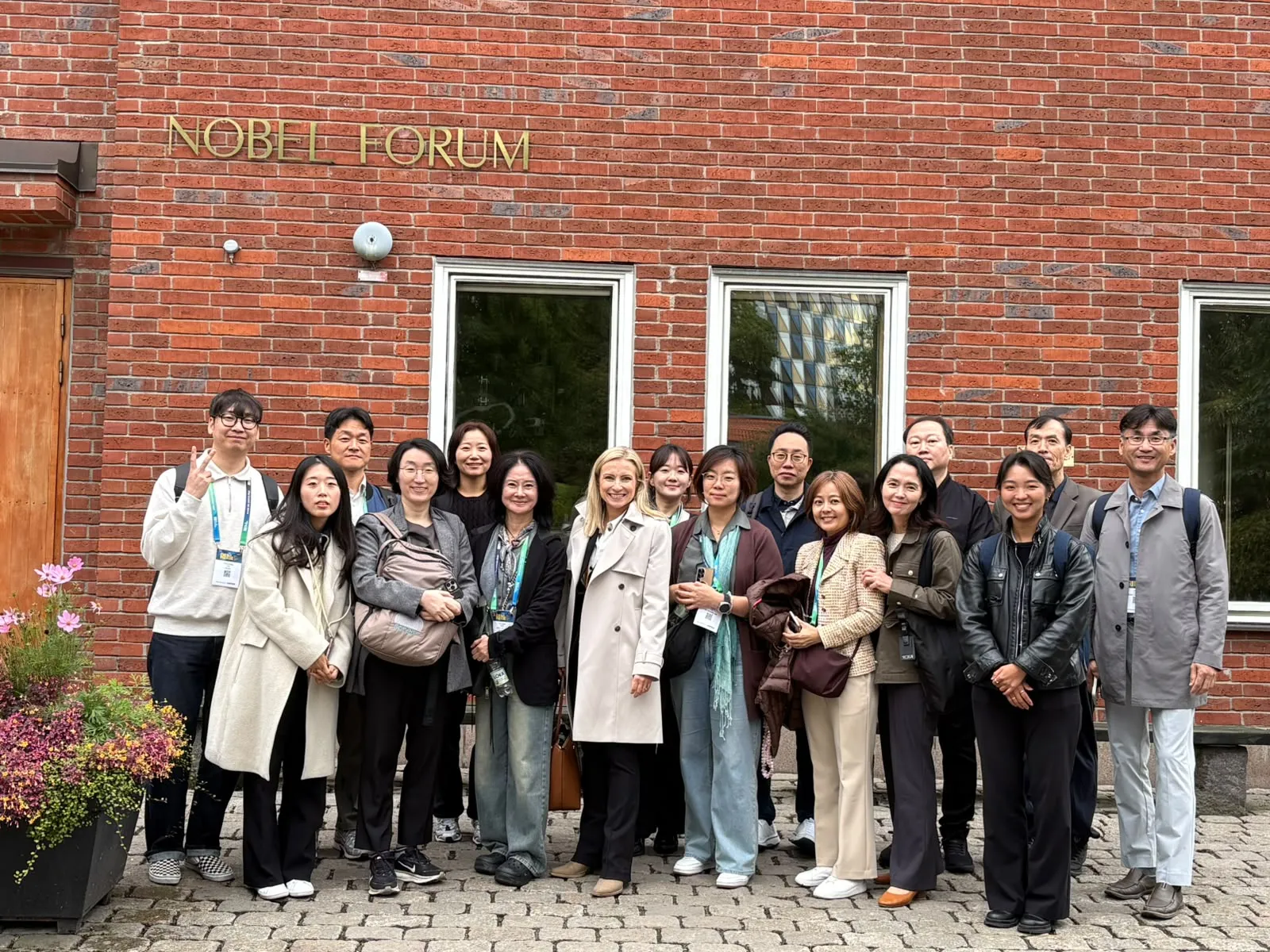
[Biobook Media] The Chungbuk Center for Creative Economy and Innovation delegation poses in front of CCRM Nordic and the Nobel Forum.
NLS Days 2026: A “small but impactful event”
Sweden is a distant country, 7404 km by air from Incheon International Airport to Stockholm Airport. It is known as a welfare state where health care is nearly free and as the country where the Nobel Prize ceremony is held. The prize was established by Alfred Nobel, the chemist and inventor who developed dynamite. Global companies such as Volvo Cars and telecommunications company Ericsson are also familiar Swedish names.
But the country is experiencing an economic downturn, driven by factors including the decline of key industries and failed immigration policies. A bleak forecast suggests its budget deficit will rise to 2.4% of GDP this year.
That raises the question of what path forward Sweden might find. The country is looking to advanced biotech and health care for an answer.
The key to its growth strategy is fostering innovative companies through active open innovation with international partners.
NLS Days, held Sept. 8-9 at the Kistamässan exhibition center in Stockholm, was an unfamiliar trade show to us. I wondered what our companies could expect from a Nordic regional gathering that was not a well-known conference such as BIO US or BIO Europe.
Those questions were answered at the event. Visitors to the Korea booth set up by the Chungbuk Center for Creative Economy and Innovation included representatives from local pharmaceutical companies and startups, CROs and regional clusters. They showed strong interest in the Korean biotech market. The atmosphere was quite different from the quiet Korea pavilion at a large trade show such as BIO US.
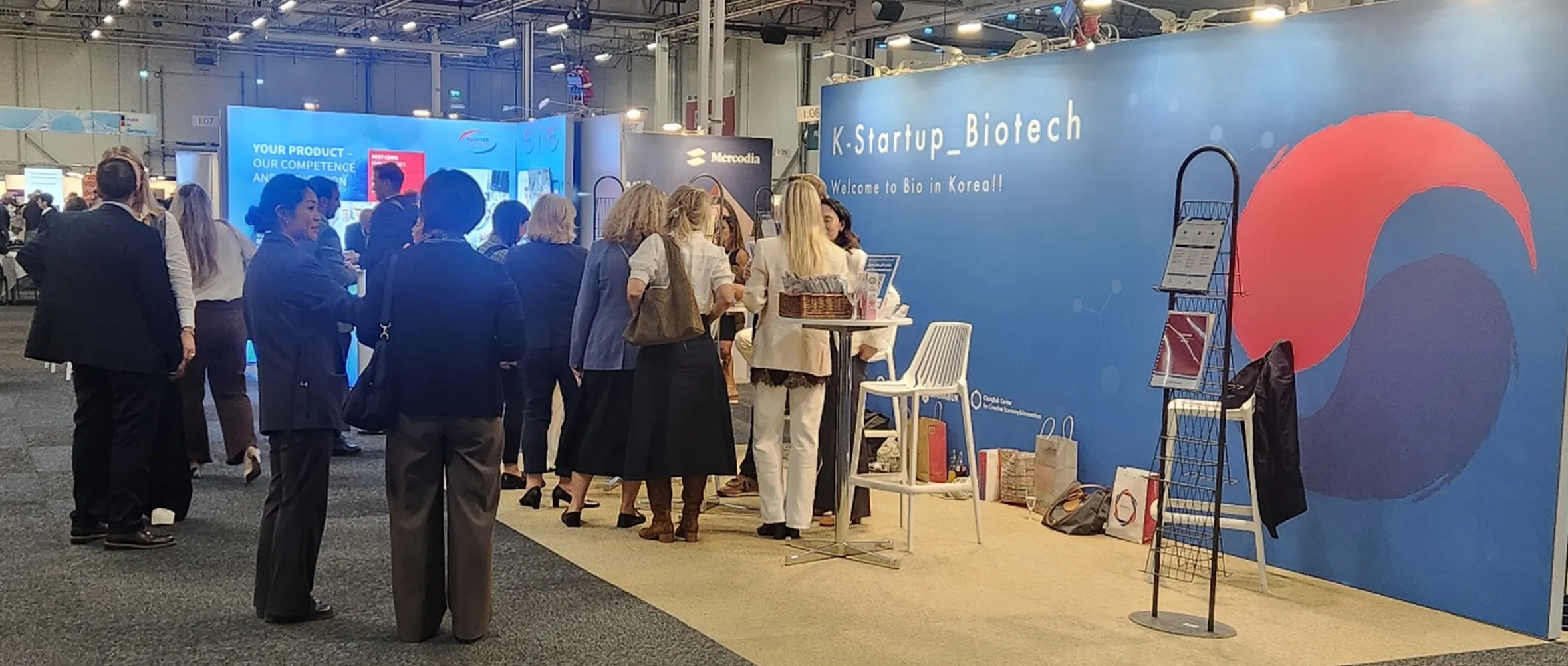
[Biobook Media] A range of international companies showed interest in the Korea pavilion at NLS Days.
Responses from the people we met during partnering sessions were even more enthusiastic. Through Biobook’s advance scheduling system, I received 34 partnering requests and, after assessing their importance, held meetings with 11 companies. It was disappointing that other commitments and the limited two-day schedule kept me from attending every meeting. The prospective partners represented a range of organizations, including the Pasteur Institute, AstraZeneca’s biotech venture, regional clusters, investment firms, information platform companies, CROs and CDMOs.
Our conversations were serious. We discussed specific areas for collaboration and scheduled follow-up video meetings. There was strong demand for finding partnering opportunities and developing customers through Biobook’s platform of information on South Korean life sciences startups.
While waiting for partnering meetings, I also found time to stay at the Korea booth and meet with about 20 companies. In all, I met with about 30 companies over two days.
I could feel how much information asymmetry there is between the two countries, given the distance between them. Paradoxically, that distance creates new business opportunities for both sides.
According to the organizers of NLS Days 2026, the event drew more than 1,500 participants from 40 countries, with 3,500 partnering meetings.
Although it was small compared with similar large international trade shows, I came away convinced that the meetings were meaningful for our companies.
Sweden’s biotech clusters: A successful example of government-led open innovation
On Sept. 10, the delegation visited SciLifeLab, Sweden’s national life sciences research infrastructure. The research institute, which focuses on molecular biology, was jointly established in 2010 by four leading Swedish universities: Karolinska Institute, KTH Royal Institute of Technology, Stockholm University and Uppsala University. One of its flagship projects is the Human Protein Atlas. Its goal is to map all human proteins found in cells, tissues and organs by integrating a range of omics technologies, including antibody-based imaging, mass spectrometry-based proteomics, transcriptomics and systems biology. The facilities that caught the delegation’s attention included an ultrahigh-resolution STED (Stimulated Emission Depletion) microscope and high-speed volumetric imaging equipment. STED microscopy is a super-resolution imaging technology that uses stimulated emission to confine fluorescence to nanoscale regions, achieving resolution beyond the diffraction limit.
During the SciLifeLab visit, we had the unexpected good fortune to meet a leading expert in imaging. We met with Hjalmar Brismar, a professor of experimental biophysics in the Department of Applied Physics at KTH Royal Institute of Technology and a world-renowned scholar who oversees Sweden’s national microscopy infrastructure, and toured key equipment and laboratories.
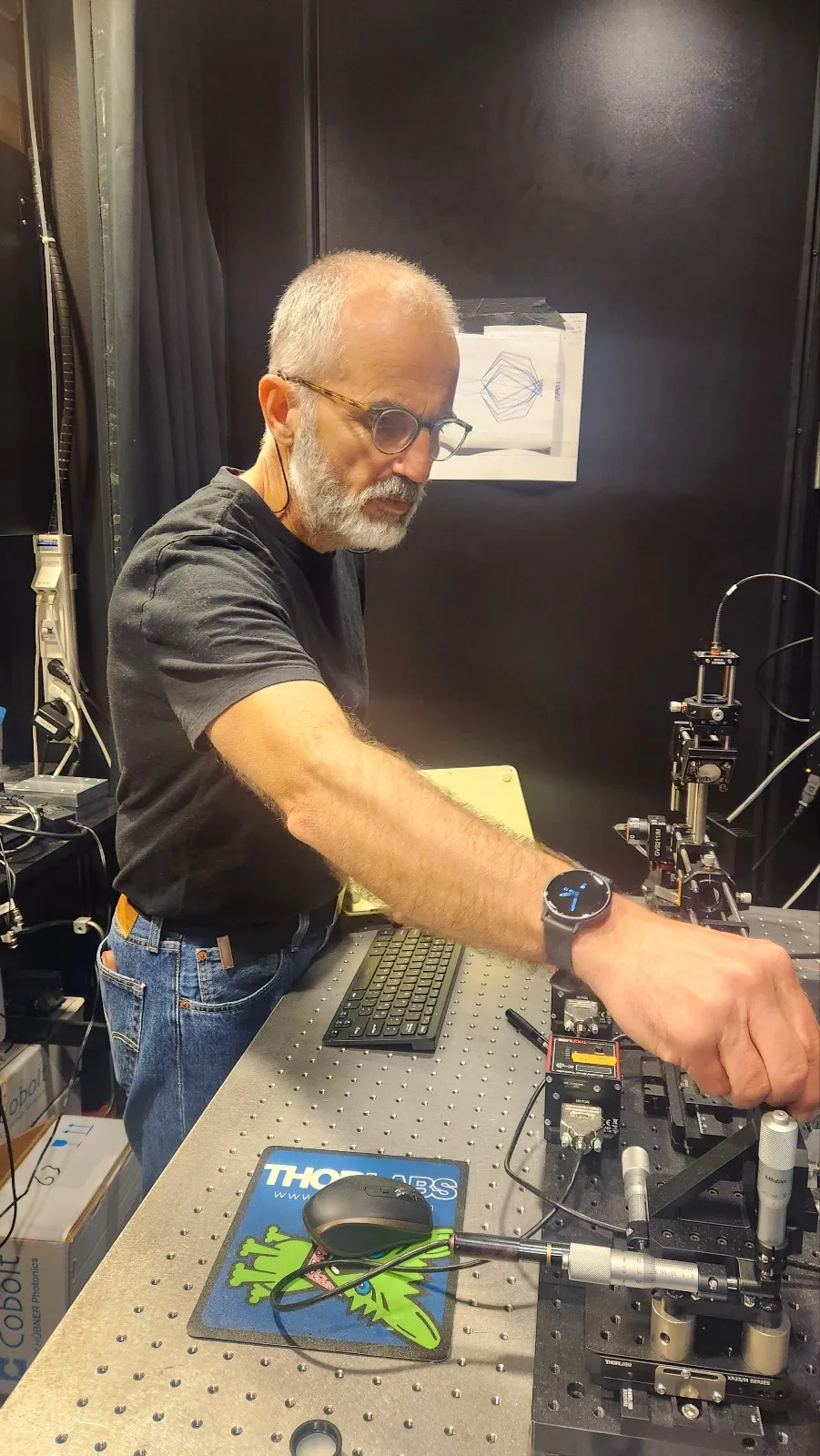
[Biobook Media] Hjalmar Brismar, a leading biophysicist, explains super-resolution imaging technology in his laboratory.
The opportunity came about when Moon Ji-sook, CEO of Recode and a member of the delegation, showed initiative by emailing Professor Brismar on the spot to request an in-person meeting after he spoke as a guest lecturer. The most striking piece of equipment was an ultrahigh-resolution optical microscope that produces 3D images of individual extracellular vesicles at a scale of 50~200 nanometers (nm).
Extracellular vesicles are lipid bilayer structures released by cells. They carry biologically active substances, including proteins, nucleic acids, lipids and metabolites, and mediate communication between cells. They play important roles in both physiological processes and disease states and are being studied as diagnostic biomarkers and drug delivery vehicles.
“With conventional optical microscopes, it is difficult to determine what is carried by individual extracellular vesicles, and this has remained a challenge,” Recode CEO Moon Ji-sook said. “Korean companies have strengths in large-scale isolation and production technologies, but they face difficulties at the characterization stage.”
SciLifeLab is an open-access support organization that provides facilities and expertise to scientists in academia and industry. It demonstrates open innovation that can drive national industrial development by sharing scientific achievements and facilities built through collaboration among government, academia and industry with researchers at large. Professor Brismar emphasized, “We don’t simply let outsiders use the equipment; we want to work together to answer scientific questions.”
GoCo Health Innovation City and CCRM Nordic offer a formula for successful industry-academia-research-hospital collaboration
On the afternoon of Sept. 10, the delegation took a cross-country train across the Nordic Peninsula to Gothenburg, Sweden’s second-largest city. The seven-hour time difference, consecutive days of partnering and visits to major facilities had left us exhausted. The demanding schedule resumed the morning of Sept. 11. The first stop was GoCo Health Innovation City in Gothenburg, where startups and aspiring entrepreneurs, major research institutes and hospitals work on joint research and development alongside large pharmaceutical companies such as AstraZeneca. The site also hosts a range of networking events and seminars. Its value chain connects research and development with GMP manufacturing and clinical work at hospitals. Companies can carry out everything from process development to production of clinical trial materials in one place. About 100 companies have reportedly succeeded in launching through the cluster and continue to grow.
We were reminded once again that a successful biotech cluster requires close connections among four key pillars: companies, universities, research institutions and hospitals.
CCRM (Centre for Commercialization of Regenerative Medicine), the nonprofit organization that operates the cluster, has maintained an ongoing relationship with the Chungbuk Center for Creative Economy and Innovation.
Results and significance
The visit to Sweden gave our biotech companies an opportunity to identify the research and development resources they need and opportunities to enter the market.
Recode is developing a cell therapy for multiple system atrophy (MSA) based on neural tube-derived stem cells (NT-SCs), as well as extracellular vesicle (EV)-based materials. With no approved treatment for the disease anywhere in the world, the company plans to pursue active collaboration with local partners in line with Europe’s rare disease drug development trends. Recode CEO Moon said, “We will pursue, in sequence, gap analysis and manufacturing collaboration with CCRM Nordic, as well as joint research on EV characterization with SciLifeLab and local universities.” CellBio, which is developing human stem cell culture media and cell therapies, is considering establishing a Swedish subsidiary. In South Korea, relevant laws make it difficult to conduct clinical trials, and research infrastructure is also weak.
If Korean companies manufacture products locally in Europe, they can receive recognition under EU GMP standards, giving them an advantage in entering the market. The Swedish side is also very active in pursuing mutually beneficial collaboration, which is
an attractive factor for Korean companies. Daphne Hingert Aldrige, CCRM’s Innovation Partnerships & Grant Manager, said, “We focus on working with external partners to improve what we don’t have.” She added, “If Korean companies’ distinctive technologies join forces with our research infrastructure, we can achieve good results.”
The significance of the visit lies in confirming the vast potential for collaboration, which cannot be captured by formal metrics such as export consultation results. It is unrealistic for Korean companies to acquire both expensive analytical equipment and EU-standard GMP facilities. Instead, they could use shared infrastructure established by Swedish national nonprofit organizations.
Biobook Comment
First, partnering requires “consistency”: ongoing, sustained contact rather than a one-time effort. The industry as a whole needs to pursue sustained partnering, as the Chungbuk Center for Creative Economy and Innovation has done through its continued networking with the Nordic region.
Byun Hyung-gyun, head of the Chungbuk Center for Creative Economy and Innovation, emphasized, “Korea-Nordic cooperation will go beyond simple technology promotion or one-off exchange events. It will become a practical and repeatable model for next-generation industrial cooperation, helping Korea’s innovative basic science yield global new drugs through the Nordic region’s robust, complementary infrastructure.”
Second, open innovation requires the ability to execute. Collaboration is possible only when we are ready to open our own doors and welcome others in. Sweden’s doors are wide open to us. Let’s develop a strategy for full-fledged partnerships.
Third, let’s make use of European research grants. Notable programs include ‘Euro star’ and ‘Horizon Europe.’ South Korea has been officially included among the countries eligible for Horizon Europe funding, allowing Korean companies and universities to form consortia with European institutions on equal terms.
Soon-jae Hong, Columnist
soonjae.hong@biobook.co.kr
Peptone nears end of two-year Lilly technology evaluation…follow-on deal could be pivotal

HLB Pharmaceutical Completes 60.8 Billion Won Rights Offering, Bets on New Hyangnam Plant as Management Participation Grows

Song Young-sook sells 86 billion won stake; buyer is daughter’s one-person company — Is a second round of Hanmi control battle looming?
