
B· Original
The $4.2 trillion AZ-BMS megadeal could reshape the global oncology market and create antitrust risks and business opportunities for South Korean biotech companies.

Megadeals between big pharmaceutical companies, which had largely disappeared since 2020, are back in the spotlight. AstraZeneca and Bristol Myers Squibb are reportedly discussing a merger valued at approximately $4.2 trillion combined, which would create the world’s fourth-largest pharmaceutical company by market capitalization if completed. With the possibility of stricter antitrust review under the Trump administration, BMS’ strategy for addressing its patent cliff and business ties with four South Korean biotechs, including Alteogen and Orum Therapeutics, all intertwined, South Korean investors will need to closely monitor the deal structure and its potential impact.
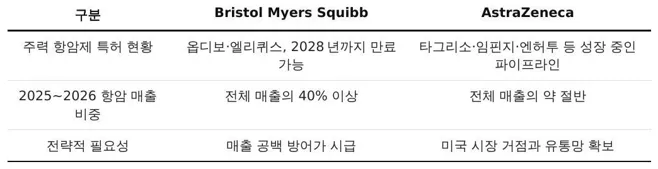
Bristol Myers Squibb acquired the blood cancer treatment Revlimid through its acquisition of Celgene in 2019. However, Revlimid has already lost patent protection. Its current leading products, the immuno-oncology drug Opdivo and anticoagulant Eliquis, are also expected to lose patent protection by 2028.
AstraZeneca has continued to grow rapidly in oncology. In 2025, oncology revenue reached approximately $25 billion, approaching half of the company’s total revenue. For Bristol Myers Squibb, securing AstraZeneca’s oncology growth engine would provide a clear strategic means of offsetting future revenue gaps.
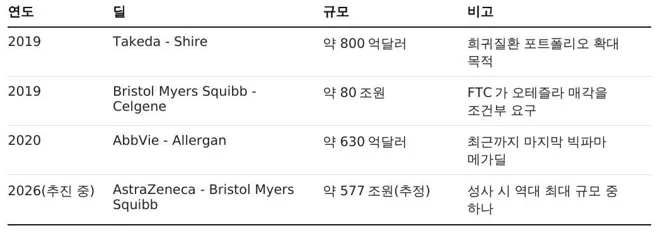
Megadeals between large pharmaceutical companies have been scarce in recent years because of antitrust concerns and pressure to lower drug prices. If completed, this deal would be the first megadeal between big pharmaceutical companies since AbbVie acquired Allergan in 2020.
The companies’ oncology portfolios overlap in more than just a limited number of indications. They were direct competitors to the extent that they were engaged in legal disputes over key immuno-oncology patents until just three years ago.
Bristol Myers Squibb’s Opdivo (nivolumab) and AstraZeneca’s Imfinzi (durvalumab) are immuno-oncology drugs targeting PD-1 and PD-L1, respectively. The two products compete for similar patient populations in major cancer types, including non-small cell lung cancer.
In March 2022, BMS filed a lawsuit in the U.S. District Court for the District of Delaware, alleging that Imfinzi infringed eight patents related to Opdivo. In 2023, it filed an additional lawsuit alleging that AstraZeneca’s CTLA-4 inhibitor Imjudo (tremelimumab) infringed patents covering its Yervoy (ipilimumab).
In August 2023, the companies ended all patent disputes under an agreement requiring AstraZeneca to pay $510 million. The possibility is now being discussed that the two companies, which once clashed over key oncology assets, could be combined into a single portfolio.
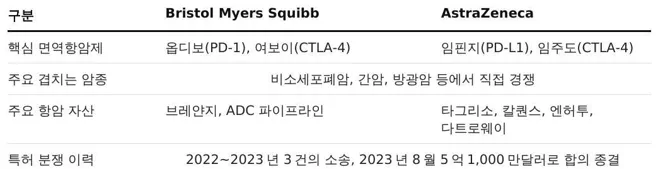
The potential for overlap is also significant when the portfolios are viewed as a whole. AstraZeneca is expanding its oncology business around Tagrisso, Imfinzi, Calquence, Enhertu and Datroway. Oncology revenue reached approximately $12 billion in the first half of 2025. BMS is also developing Breyanzi, a CAR T-cell therapy, and its ADC pipeline as next-generation growth drivers in addition to Opdivo and Yervoy.
This business overlap is considered a key regulatory variable in the deal. Antitrust attorney Andre Barlow said that substantial asset divestitures could be required if overlap among late-stage clinical assets is significant. BMO Capital Markets also assessed that overlap between the companies’ therapeutic areas could reduce the likelihood of the transaction.
The U.S. merger guidelines revised in 2023 strengthened the criteria for assessing market concentration and potential restrictions on competition. As a result, the review could be stricter than it was when BMS acquired Celgene. There is also a possibility that the sale of certain products or late-stage pipeline assets could be required for approval.

However, in past acquisitions involving large pharmaceutical companies, regulators have often approved transactions subject to the divestiture of overlapping assets rather than blocking the deals outright. Accordingly, the key issue going forward is likely to be not whether the merger is approved, but which products and pipeline assets are included in any divestitures or adjustments.
Antitrust review by the Federal Trade Commission (FTC) is a key variable in the transaction. The FTC examines whether large mergers and acquisitions restrict market competition or excessively increase concentration in specific therapeutic markets.
When BMS acquired Celgene in 2019, the FTC required the divestiture of the psoriasis treatment Otezla as a condition of approval. BMS completed the transaction after selling Otezla to Amgen. This time, too, if the overlap between the companies’ oncology portfolios is deemed substantial, the divestiture of certain products or pipeline assets could be required.
The impact on South Korean biotechs could also vary depending on the outcome of the review.
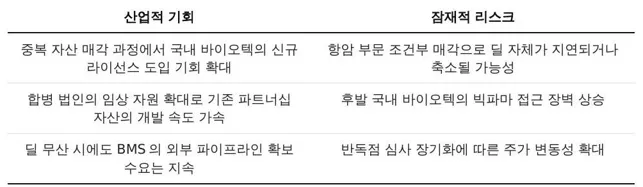
The transaction could also have a direct impact on South Korean biotechs. AstraZeneca and Bristol Myers Squibb have established licensing and collaborative research relationships with South Korean companies, including Alteogen and Orum Therapeutics.
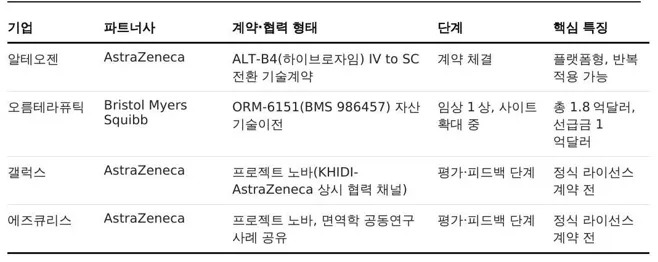
Herald Economy analyzed that the merger could bring both opportunities and risks to South Korean biotechs. If the streamlining of overlapping pipelines proceeds alongside the introduction of new technologies, licensing-out opportunities for South Korean companies could expand. On the other hand, stronger clinical development capabilities at the combined company could further raise barriers to market entry for later-arriving biotechs.
① Antitrust review is the deal’s biggest variable
• Given the Celgene-Otezla divestiture precedent, some overlapping oncology assets could be subject to conditional divestiture.
• This is also relevant to the future of South Korean assets tied to Bristol Myers Squibb’s oncology pipeline, such as those of Orum Therapeutics.
② Differences among analysts reflect the scale of the uncertainty
• Some analysts view the portfolios as complementary, while others are concerned about anticompetitive issues.
• Share-price volatility is likely to continue until the regulatory review is completed.
③ The patent cliff is a fundamental pressure that will not disappear even if the deal falls through
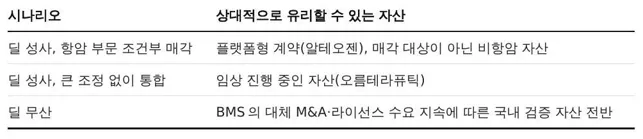
• With patent expirations for Bristol Myers Squibb’s Opdivo and Eliquis scheduled for 2028, the company is likely to pursue other forms of M&A or licensing if the transaction fails.
• The negotiating power of companies with validated pipelines, such as Orum Therapeutics, could remain intact regardless of whether the deal is completed.
④ The assets that benefit vary by scenario
This content is provided for informational purposes and is not investment advice. Estimates of company value vary by media outlet, and the contract terms and detailed milestone amounts should be separately confirmed through each company’s public disclosures. ⓒ Biobook
Biobook Team
biobook@biobook.co.krShin Dong-kook Raises Stake in Hanmi Science to 30.18% With Over-the-Counter Purchase of 1.38 Million Shares
PharmaResearch’s Third-Quarter Operating Profit Reaches 186.4 Billion Won, Up 14.7% Year Over Year
Hanmi Science Controlling Shareholder Group Maintains 71.15% Stake as Share Purchase Agreement Closes


